
Learn more
British Values
British Values
In accordance with The Department for Education, at the Schools of Woolton Hill we aim to actively promote British values to ensure our young people leave school prepared for life in modern Britain. Pupils are encouraged to regard people of all faiths, races and cultures with respect and tolerance and understand that while different people may hold different views about what is ‘right’ and ‘wrong’, all people living in England are subject to its law.
British values are promoted in so much of what we do, not least during our daily acts of worship, Religious Education and Citizenship curriculum. The values are integral to our vision and values where we want our children to show respect, make wise choices and show courage in their learning. As well as actively promoting British values, the opposite also applies: we actively challenge pupils, staff or parents expressing opinions contrary to fundamental British values.
Key values are
Democracy
Rule of law
Individual liberty
Mutual respect
Tolerance of those of different faiths and belief
Being part of Britain
As a school, we value and celebrate the diverse heritages of everybody at Woolton Hill. Alongside this, we value and celebrate being part of Britain. In general terms, this means that we celebrate traditions, such as customs, festivals and commemorations in the course of the year; for example, Harvest festival during the autumn term, Remembrance Sunday, Christmas and Easter. More specifically, we learn about Britain through our Geography and History curriculum and through stories within our English curriculum.
Democracy
At the Schools of Woolton Hill, children, parents and staff have many opportunities for their voices to be heard. Democracy is central to how we operate. An obvious example is our school Leadership roles. The election of these reflects our British electoral system and demonstrates democracy in action: candidates make speeches, pupils consider characteristics important for an elected representative, pupils vote in secret using ballot boxes etc. Leadership roles such as School Council are representatives from each year group, they meet regularly to discuss issues raised by the different classes, plan events for the whole school and opportunities to demonstrate courageous advocacy. Many of our Leadership roles have opportunity to spend from the school budget and are able to genuinely effect change within the school.
Other examples of ‘pupil voice’ are:
-
Children agree their Class Charter and the rights associated with these; all children contribute to the drawing up of the charter.
-
Children nominate various charities. A voting system allows all children to make their own choices. From these choices, various charities are supported throughout the year.
-
Children attending their own Annual Review meetings and engaging in discussions about their next steps in learning.
In our schools, pupils are always listened to by adults and through our oracy work are taught how to listen carefully to each other, respecting the right of every individual to have their opinions and voices heard.


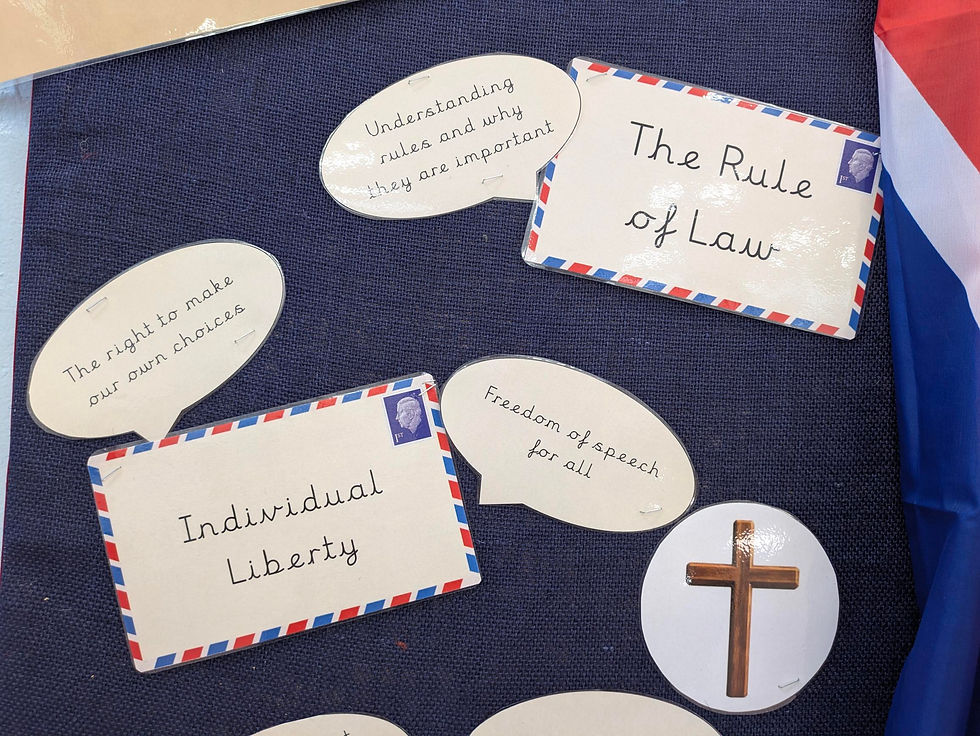

Rule & Laws
The importance of rules and laws, whether they be those that govern our school or our country, are referred to and reinforced often, such as in collective worship and when reflecting on behaviour choices. At the start of the school year, each class discusses and sets its own Class Charter, a set of principles that are clearly understood by all and seen to be necessary to ensure that every class member is able to learn in a safe and ordered environment. Pupils are taught the value and reasons behind laws, that they govern and protect us, the responsibilities that this involves, and the consequences when laws are broken.
These values are reinforced in different ways:
-
During Religious Education, when rules for particular faiths are thought about
-
During other school subjects, where there is respect and appreciation for different rules for example in a sports lesson or when on a trip.
-
Visits from authorities such as the police and fire service
Individual Liberty
At the Schools of Woolton Hill, we promote freedom of choice and the right to respectfully express views and beliefs. Through the provision of a safe, supportive environment and empowering education, we provide boundaries for our young pupils to make choices safely; for example:
-
choices about who they prefer to learn with in some activities
-
choices about how they record some learning
-
choices around the participation in extra-curricular activities
-
choices from a variety of activities at lunchtime.
Our pupils are encouraged to know, understand and exercise their rights and personal freedoms and are taught how to exercise these safely. We place a high regard on e-safety and are explicit with children about why they need to make the right choices when online.
Mutual respect and tolerance of those with different faiths and beliefs
Our pupils know and understand that it is expected and imperative that respect is shown to everyone, whatever differences we may have, and to everything, whether it is a school resource, a religious belief or whatever. It is a school value we teach about and discuss regularly in school. Children learn that their behaviour choices have an effect on their own rights and those of others. Specific examples of how we at Woolton Hill enhance pupils understanding and respect for different faiths and beliefs are:
-
Through Religious Education, Citizenship and Global Neighbours assemblies where we might develop awareness and appreciation of other cultures – in English through fiction and in Art by considering culture from other parts of the world.
-
Through collective worship where we celebrate diversity and difference. Children enjoy learning about other faiths and cultures. Great emphasis is placed on our identity as individuals, families and communities.
No school can guarantee that there will never be instances which are contrary to the British Values. At Woolton Hill, such instances are extremely rare. They are treated seriously in line with school policies.